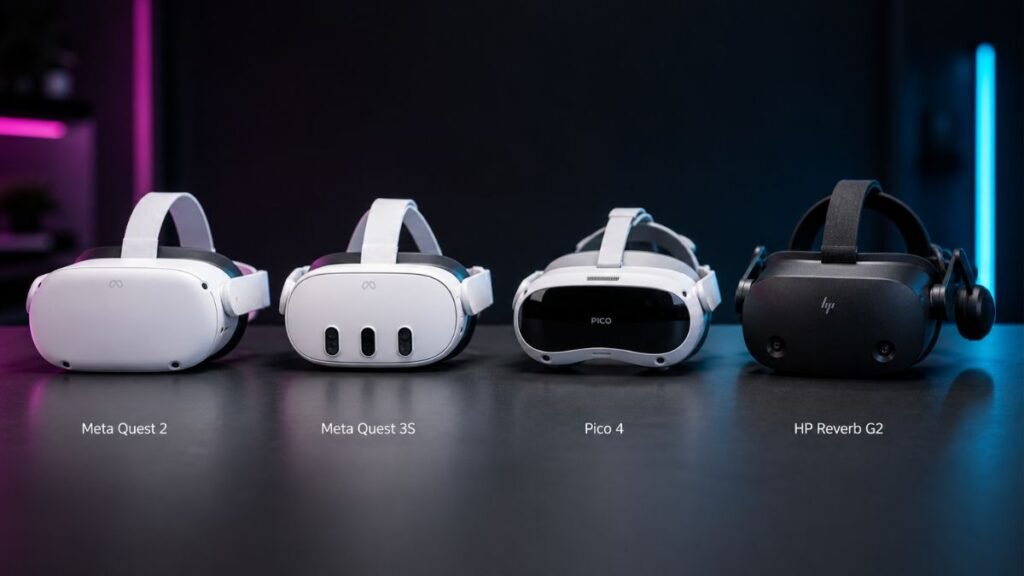
Best Budget VR Headsets Under $300 in 2026
Best budget VR headsets under $300 are harder to find in 2026 because rising hardware costs pushed entry-level VR above the old $299 sweet spot. A few years ago, finding a quality headset under $300 was easy. Today, buyers must navigate refurbished listings, clearance bundles, used hardware, and hidden accessory costs to stay within budget.
The VR market changed fast. Supply chain shortages, rising RAM prices, and growing AI hardware demand pushed manufacturers to raise prices across the board. Even Meta’s Quest 3S crossed the $300 threshold after launch. That shift created a new type of budget buyer. People now compare not only price but long-term value, software support, comfort, and upgrade costs.
This guide breaks down the best affordable VR headsets still worth buying in 2026. You will learn which headsets perform best for beginners, PCVR players, sim racers, media viewers, and long-term value seekers. You will also see the hidden costs most buyers ignore before they purchase their first headset.
Why Budget VR Changed in 2026
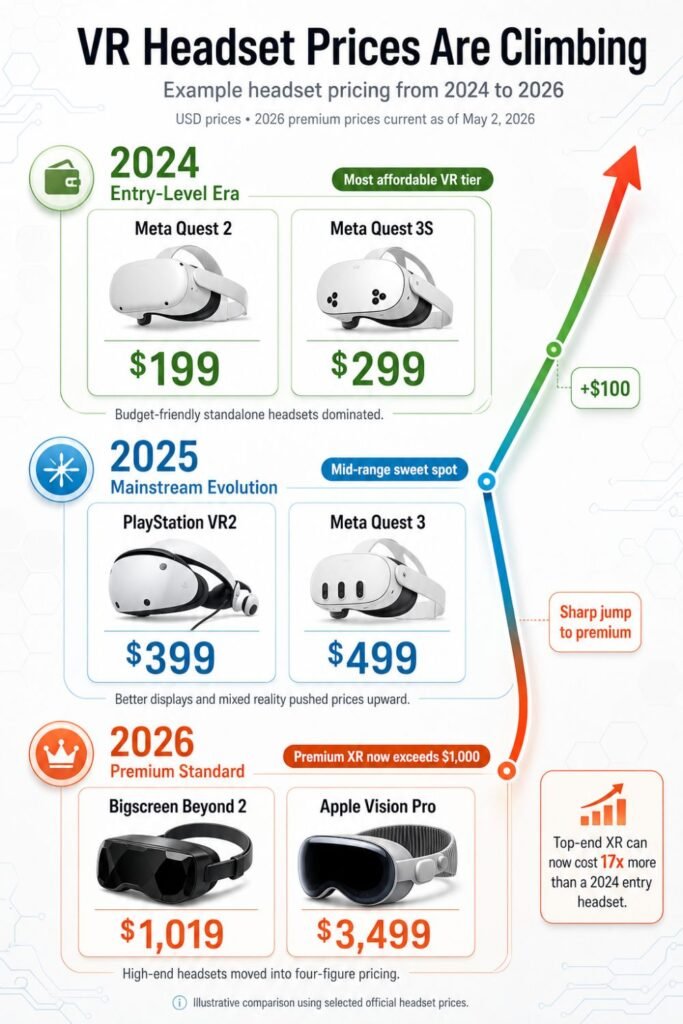
For years, $299 served as the unofficial entry point for mainstream VR adoption. Manufacturers built hardware around hitting that price target. The goal was simple. Make VR affordable enough for average buyers.
That changed during the first quarter of 2026.
Global memory shortages increased RAM prices by nearly 80% to 90%, forcing manufacturers to raise prices across the VR industry. Many analysts refer to this period as “RAMageddon.” Hardware companies faced shrinking profit margins and increased component costs. Instead of lowering prices on older devices, many brands increased prices to protect margins.
The result created a new market reality:
- Entry-level VR is no longer truly cheap
- Budget buyers rely on refurbished and clearance inventory
- Older headsets regained value
- PCVR hardware became attractive again
- Used markets exploded in popularity
This shift changed how buyers should think about affordable VR.
Budget no longer means cheapest.
Budget now means highest value per dollar.
The New Rules of Buying Budget VR
Buying affordable VR in 2026 requires strategy.
A low sticker price does not guarantee good value.
You must evaluate:
- Processor generation
- Lens quality
- Software longevity
- Ecosystem support
- Upgrade requirements
- Comfort accessories
- Battery life
- Tracking reliability
Many cheap headsets fail because they cannot run newer VR titles.
Software support matters more than raw resolution.
A headset running an older chipset risks becoming obsolete faster than expected. Snapdragon XR2 Gen 2 devices now define the modern baseline for standalone VR performance. Older XR2 Gen 1 hardware still works, but long-term compatibility becomes questionable for future AAA releases.
The goal is not finding the cheapest headset.
The goal is avoiding buyer regret.
Top Budget VR Headsets Under $300 Ranked
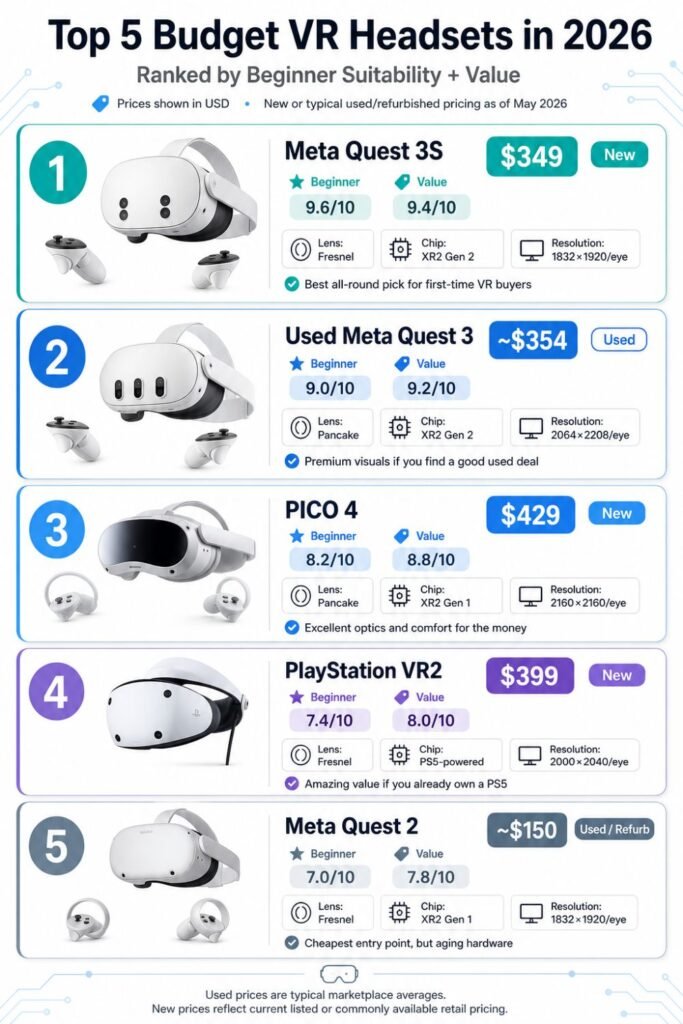
- Meta Quest 3S
Best Overall Budget VR Headset
The Quest 3S dominates the affordable VR category because it includes the same Snapdragon XR2 Gen 2 processor used inside the more expensive Quest 3.
That matters more than most buyers realize.
The processor controls:
- Game compatibility
- Mixed reality performance
- Tracking accuracy
- Passthrough quality
- Future software support
While Meta reused Fresnel lenses to keep costs lower, the headset still delivers excellent standalone performance.
Pros:
- Same processor as Quest 3
- Strong standalone library
- Great beginner setup
- Full-color passthrough
- Easy ecosystem access
Cons:
- Fresnel lens blur at edges
- Weak default head strap
- Short battery life
Typical 2026 Price:
$249 to $299 through bundles, refurbished programs, and sales.
Best For:
Beginners who want one headset for gaming, fitness, media, and mixed reality.
- Pico 4
Best Optical Quality Under $300
The Pico 4 remains one of the strongest budget alternatives because of its pancake lenses.
Pancake optics create:
- Better clarity
- Slimmer headset shape
- Reduced eye strain
- Better edge-to-edge sharpness
Many users prefer Pico 4 visuals over Quest 3S despite the older processor.
The trade-off comes down to software.
Meta dominates content.
Pico wins on hardware comfort.
Pros:
- Pancake lenses
- Better weight balance
- High-resolution displays
- Excellent PCVR streaming
Cons:
- Smaller app ecosystem
- Limited North American availability
- Older XR2 Gen 1 processor
Typical Price:
$220 to $290 used or imported.
Best For:
Media viewing, PCVR streaming, long play sessions.
- HP Reverb G2
Best for Sim Racing and Flight Sims
The HP Reverb G2 continues to survive because visual clarity still matters.
Its 2160 x 2160 per-eye resolution remains impressive even in 2026.
Community-built Oasis drivers revived compatibility after Microsoft abandoned Windows Mixed Reality support.
Pros:
- Outstanding clarity
- Excellent off-ear speakers
- Zero compression
- DisplayPort PCVR
Cons:
- Technical setup required
- Not standalone
- Weak controller tracking
Typical Price:
$150 to $250 used.
Best For:
Flight sims, racing sims, cockpit games.
- Meta Quest 2
Best Ultra-Budget Option
The Quest 2 remains one of the cheapest ways to enter VR.
While aging hardware limits future compatibility, it still supports:
- Beat Saber
- VR fitness
- Casual gaming
- PCVR streaming
- Video viewing
Pros:
- Extremely cheap
- Large game library
- Easy to find used
Cons:
- Older chipset
- End-of-life concerns
- Weak passthrough
Typical Price:
$80 to $150 used.
Best For:
Trying VR for the first time.
- Pico Neo 3 Link
Best Wired PCVR Budget Option
The Pico Neo 3 Link offers something rare.
Native DisplayPort.
Unlike wireless streaming, DisplayPort removes compression and latency.
This matters for competitive PCVR users.
Pros:
- Native DisplayPort
- Low latency
- Reliable PCVR
Cons:
- Harder to find
- Older optics
- Limited standalone support
Typical Price:
$220 to $300 used.
Best For:
Dedicated PC gamers.
Hidden Costs Most Buyers Ignore
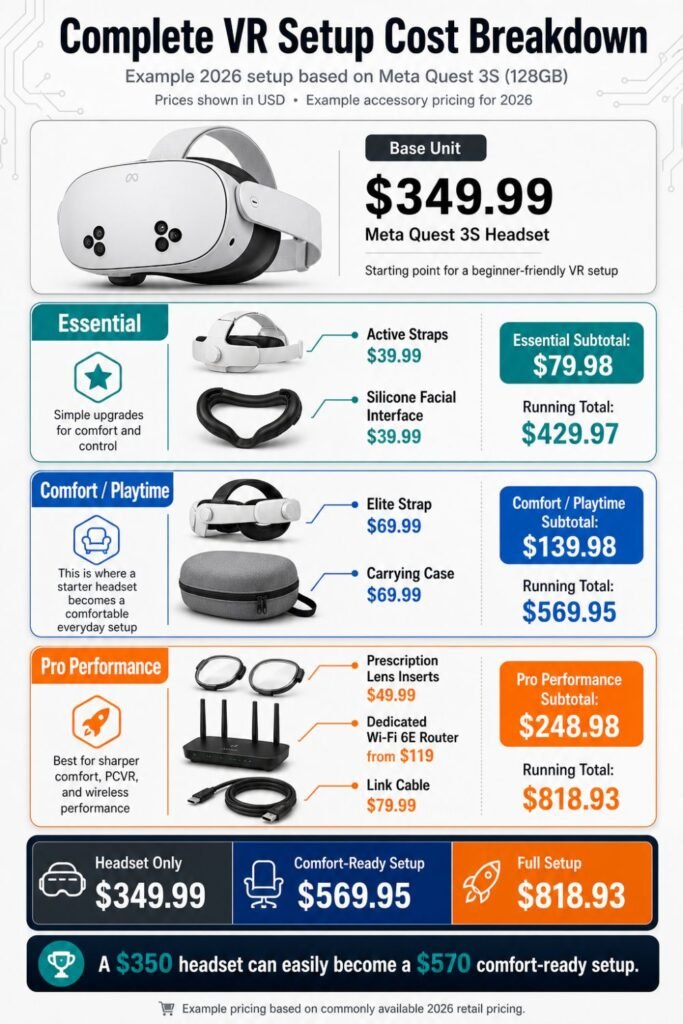
Budget VR rarely stays budget.
Most headsets require upgrades.
Common hidden costs include:
- Better head straps
- Battery packs
- Prescription lens inserts
- Facial interfaces
- Link cables
- Wi-Fi 6 router upgrades
A $299 headset often becomes a $400 setup quickly.
Common Beginner Mistakes
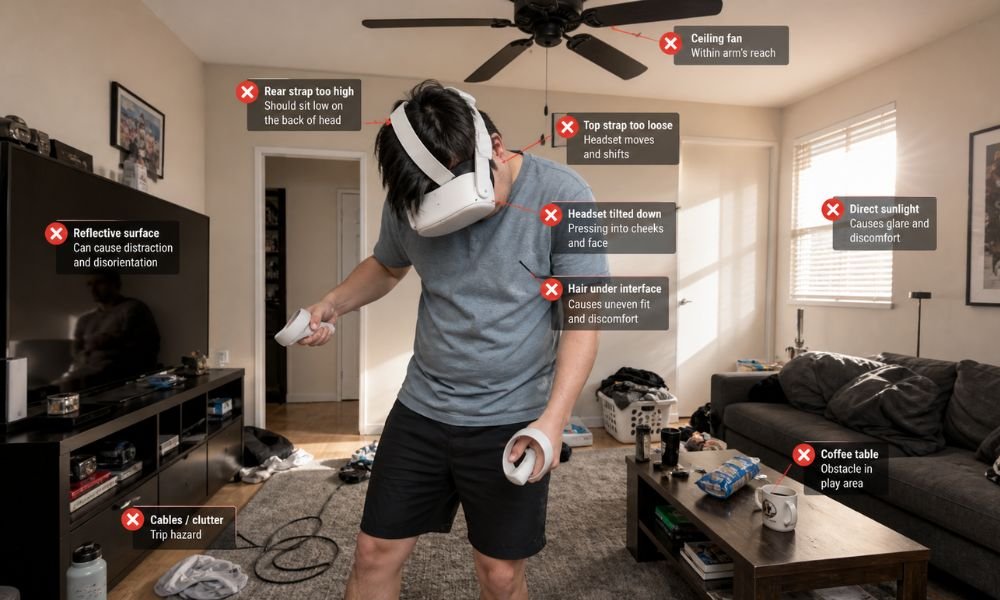
New VR buyers often make avoidable mistakes.
Biggest problems include:
- Buying based only on resolution
- Ignoring lens quality
- Choosing outdated processors
- Forgetting comfort upgrades
- Using poor Wi-Fi for PCVR
- Playing intense motion games too early
These mistakes create motion sickness and frustration.
Which Budget VR Headset Should You Buy?
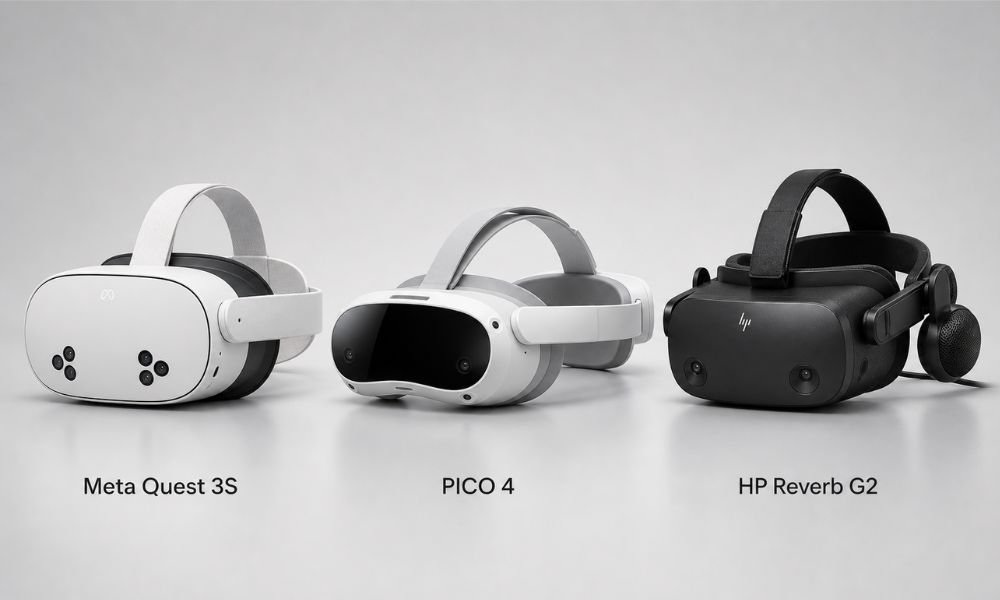
Choose Quest 3S if:
- You want easiest setup
- You want standalone gaming
- You care about future-proofing
Choose Pico 4 if:
- You want better optics
- You care about comfort
- You use PCVR often
Choose HP Reverb G2 if:
- You own a gaming PC
- You play simulators
- You want maximum clarity
Choose Quest 2 if:
- You want cheapest entry
- You are testing VR casually
Choose Pico Neo 3 Link if:
- You hate wireless latency
- You want DisplayPort PCVR
Final Verdict
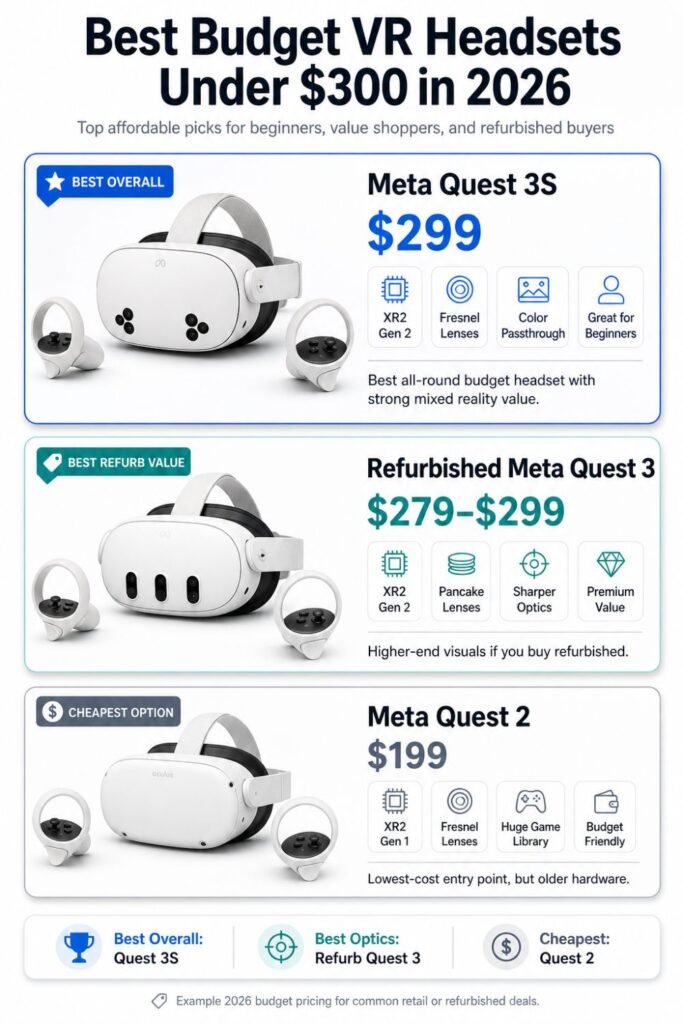
Best budget VR headsets under $300 still exist in 2026, but buyers must think differently.
Price matters less than ecosystem value.
The Quest 3S wins because it balances performance, longevity, and accessibility.
The Pico 4 wins for comfort.
The HP Reverb G2 wins for clarity.
The best budget headset depends on how you plan to use VR.
Cheap does not mean bad.
Cheap means strategic.